
Addressing critical equipment maintenance and monitoring myths

Unplanned equipment failure rarely happens at a convenient time. When a motor, transformer, mechanical system, or any other critical piece of equipment fails without warning, the impact can quickly devastate an organization. Production slows or stops, and maintenance teams are pulled in to diagnose the situation and perform emergency repairs.
Today’s supply chain challenges often compound the disruption. Replacement lead times for critical assets are now commonly months or even years. Sensors, power modules and passive components can face procurement timelines of up to 60 weeks, while large power transformers often carry lead times of up to 36 months.1
Preventive maintenance is designed to reduce these risks by identifying developing issues early, allowing organizations to plan intervention rather than respond under pressure. Condition monitoring provides earlier, highly reliable insights into equipment performance, so it is possible to address any anticipated problems proactively.
Myth: Any monitoring device is acceptable.
Reality: Early warnings from tested and certified monitoring equipment are more reliable.
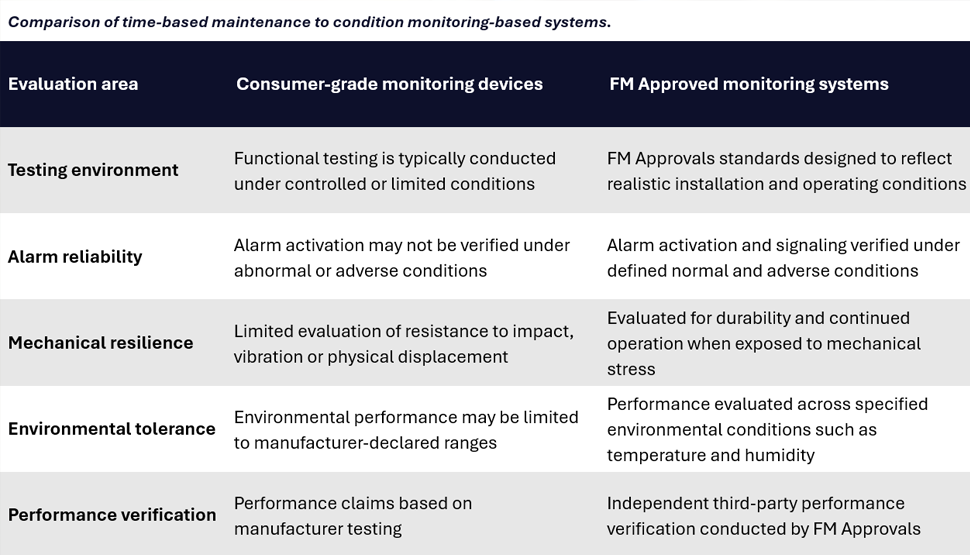
At a glance, many condition monitoring devices appear similar. Sensors collect data, systems generate alerts, and dashboards promise visibility. However, performance on a specification sheet does not always translate to reliable operation in the environments where monitoring equipment is installed.
In real-world settings, monitoring devices may be exposed to vibration, physical impact, humidity, temperature extremes, and high-energy events such as pressurized water releases. Without sufficient mechanical robustness or environmental tolerance, sensors may be displaced or damaged, compromising their ability to operate as intended. When alarms fail to activate under these conditions, detection can be delayed, allowing damage to escalate unhindered before any indication that corrective action is needed. Failures can also occur when monitoring devices are not designed to withstand physical forces encountered in service.
FM Approvals evaluates condition monitoring equipment under realistic conditions. During the FM Approvals certification process, products are tested against defined performance criteria that are consistent with the stresses encountered in application.
To meet the requirements of FM 6510 (Condition Monitoring Systems for Switchgear Equipment), FM 6520 (Dissolved Gas Analysis Monitoring Systems in Liquid-Immersed Transformers), FM 6530 (Condition Monitoring of Rotating Machinery), or FM 6550 (Acoustic Condition Monitoring of Wind Turbines) – many product manufacturers design devices with the testing protocols in mind. When manufacturers design products to meet the requirements of FM Approvals Examination Standards, the final products often include features that maintain durability, ensure reliability, and increase resistance to environmental exposure.
While no condition monitoring system can detect and report on all early signs of failures, independently tested and certified systems provide greater confidence that early warning will be delivered when conditions are most challenging, supporting more effective preventative maintenance decisions.
Myth 2: Recommended maintenance intervals are always reliable.
Reality: Fixed maintenance schedules cannot account for how equipment is actually used.
Manufacturer-recommended maintenance intervals provide a useful baseline and often work well. However, fixed schedules are based on generalized assumptions and cannot reflect how individual assets age over time.
Equipment rarely operates under uniform conditions. Seasonal demand can increase loads on motors and mechanical systems. For example, heating equipment may run continuously during cold months. Industrial machinery may be pushed harder during peak production periods. In these scenarios, a static maintenance schedule may delay necessary intervention or prompt premature maintenance.
Condition monitoring is most valuable when applied to equipment whose failure would have the greatest operational impact. Assets that are critical to safety, production continuity or system reliability benefit from early, reliable alerts that allow emerging issues to be addressed before disruptions occur. FM Approved condition monitoring equipment supports this approach by independently verifying performance to a consistent set of globally recognized requirements found within the relevant FM Approvals Examination Standards.
Myth 3: Equipment failure is unpredictable.
Reality: Most failures occur after detectable, early indicators.
Equipment failures often appear sudden, but in many cases, they are preceded by measurable changes. Before a system stops functioning, conditions such as rising temperatures, abnormal vibration, moisture ingress, or gas formation may begin to develop.
Lithium-ion battery energy storage systems offer a clear example. In Battery Energy Storage Systems (BESS) applications, internal faults or cell degradation may lead to off-gas release before more visible signs of failure occur. FM’s published guidance on lithium-ion battery hazards explains how thermal runaway develops and underscores the importance of detecting these early changes before escalation occurs. Condition monitoring technologies designed for these environments can provide a limited but critical window to isolate affected modules and reduce the risk of a more serious event.
FM Approvals evaluates these types of systems with FM Approvals Examination Standard 6540 for Lithium-Ion Battery Off-Gas Detection, which focuses on verifying system performance under defined conditions.
This capability is especially important in applications where small internal faults can escalate quickly if left undetected. By identifying early indicators and verifying that monitoring systems perform reliably under real-world conditions, organizations can better support proactive maintenance strategies and reduce the likelihood of unexpected disruptions.
Reliable insight supports proactive maintenance
Preventative maintenance is not achieved simply by installing sensors or following fixed schedules. It requires reliable insight delivered consistently over time. Condition monitoring systems that perform as expected under real-world conditions provide the early warnings organizations need to act before failures can disrupt operations.
FM Approvals verifies that condition monitoring equipment meets defined performance criteria. This evaluation gives manufacturers a credible way to demonstrate reliability and helps facility owners select equipment that has been independently tested for real operating environments.
If your organization manufactures property loss prevention products and would like to begin the certification process, apply for certification or find an FM Approvals office near you.
To learn more about products we certify and our Examination Standards, visit fmapprovals.com. To find all FM Approved products, visit the Approval Guide.
1Sourceability “Q3 2025 Lead Time Report,” October 2025.