
Lithium-ion battery off-gas detection systems recognize the early signs of potential thermal runaway and fire hazards

The global data center lithium-ion battery market is driving the future of sustainable backup power and is projected to triple from $5.9 billion in 2025 to $17.7 billion by 2034. This trend reflects the rapid adoption of this technology’s scalability and performance advantages. Yet as reliance on lithium-ion grows, so do the associated risks. The early monitoring is crucial to help prevent potential failures that may lead to thermal runaway, a self-sustaining reaction that generates intense heat and flammable gases across multiple cells.
Around the world, several large-scale lithium-ion battery fires demonstrate just how quickly small malfunctions can escalate into major disasters. In early 2025, a blaze at a major battery facility in California destroyed much of the site and forced the evacuation of nearby residents. A few years earlier, in Australia, a “megapack” caught fire during testing, burning for four days and requiring more than 150 firefighters to contain. Similar incidents have occurred at an energy storage plant in Arizona, a warehouse in Illinois, and facilities in South Korea.
Thermal runaway events can escalate in under a minute, leaving little time for conventional smoke or temperature sensors to provide information needed to respond. For facility owners, developers, and product manufacturers, this narrow window underscores an urgent question: How can an upcoming failure be detected before it ignites a fire?
A new class of off-gas detection systems is providing answers. By sensing the gases released in the earliest stages of cell degradation — before smoke or fire are visible — this technology will enable intervention that can isolate a faulty battery, protect surrounding modules, and help prevent a total loss.
To help validate and standardize these emerging detection systems, FM Approvals Examination Standard 6540 establishes the testing and certification requirements that are used to evaluate the performance of off-gas detection systems.
How off-gas detection works
Traditional detection systems for smoke, heat or gas, often respond after a battery cell has entered thermal runaway – when heat, pressure, and flames are already building up. At that stage, the event is self-sustaining and difficult to contain. Off-gas detection represents a critical shift from reaction to prevention.
When lithium-ion batteries begin to degrade, they release organic compounds and gases such as hydrogen, carbon dioxide, and volatile electrolyte vapors. These gases can appear minutes before heat or smoke becomes detectable. Monitoring this phase provides a unique opportunity to act while the situation is still controllable.
Off-gas detection systems continuously sample the air around battery modules and measure the rate of change — or rate-of-rise — in gas concentration, rather than waiting for levels to exceed a fixed threshold. A sudden acceleration in gas generation indicates that one or more cells are venting abnormally, signaling the onset of thermal instability.
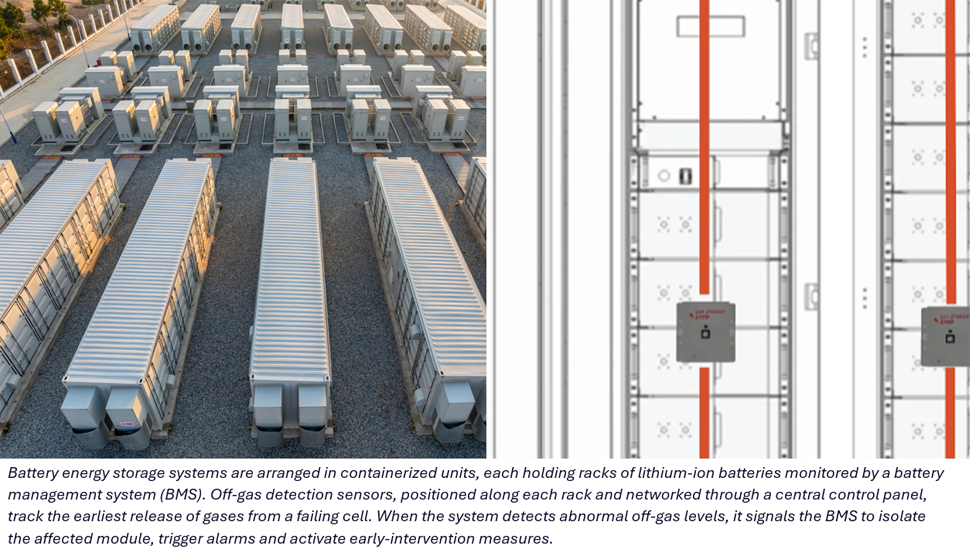
Once this change is detected, the system can automatically alert operators or trigger a direct response through the battery management system (BMS). That may include:
- Isolating the affected module or cell from the rest of the array
- Reducing load or charge rates to stop further stress
- Activating ventilation to disperse accumulated gases
- Notifying personnel for inspection or maintenance
In large-scale battery energy storage systems (BESS), this can mean saving an entire container by disconnecting only a single module. In data centers, it may prevent downtime or protect critical servers from heat and smoke damage. By detecting failure early, off-gas monitoring transforms what could be a total loss event into a manageable maintenance incident.
Inside FM 6540: A Benchmark for Battery Safety
As lithium-ion technology evolves, so must the methods used to verify its safety. To ensure that off-gas detection systems perform reliably in the environments where they’re deployed, FM Approvals Examination 6540 provides the first independent certification program for rate-of-rise gas detection instruments for lithium-ion battery systems.
Unlike traditional gas-detection standards that evaluate devices based on a fixed concentration threshold, FM 6540 measures a detector’s ability to identify the rate of change in gas concentration and validates that the system can recognize this rapid change and trigger the appropriate alarm or automated response within seconds.
This certification offers manufacturers a credible way to demonstrate performance, and gives owners, developers, and insurers confidence that technologies deliver proven, real-world reliability.
See the following FM Approvals article from February 2025 for a look inside the approval process: FM Approved Lithium-Ion Battery Off-Gas Detector works to prevent thermal runaway and mitigate fire hazards.
Early detection changes everything
In a lithium-ion battery system, thermal runaway is the point of no return. The reaction accelerates exponentially, feeding the next cell. Off-gas detection technology changes that outcome by giving operators a window to act before ignition ever occurs. Detecting and isolating a single failing module can prevent the loss of an entire energy storage container, reduce downtime, and protect surrounding equipment and personnel.
For owners, developers, and manufacturers, this early-intervention capability translates directly into greater resilience and reliability. Facilities stay online longer. Damage is contained faster. Risk has been dramatically reduced. And as the global use of lithium-ion systems expands — from grid-scale storage to mission-critical data centers — the assurance that these technologies will perform as intended becomes increasingly essential.
FM Approvals helps bridge innovation and proven performance. Operating from locations all around the world, FM Approvals supports the availability of tested and certified loss prevention products in key markets. For manufacturers seeking distribution into new markets, completing the FM Approvals certification process can open doors since the FM APPROVED certification mark is globally recognized and associated with quality, technical integrity, and performance.
Certified systems deliver measurable reliability in real-world environments, giving organizations confidence that they’re not just adopting new technology but investing in safer, more sustainable energy infrastructure for the future.
If your organization manufactures off-gas detection systems or other fire protection technologies for lithium-ion batteries, begin the FM Approvals certification process by applying online or contacting Patrick Byrne (FM Approvals, Operations Vice President, Group Manager – Electrical Systems) at [email protected].
Learn more about products we certify and our Examination Standards. To find listings of all FM Approved products, visit the Approval Guide.