
The growing role of early flood and liquid leak detection in support of climate resilience
Advances in detection technologies are helping facilities anticipate threats and be more resilient

The presence of unwanted water and other escaped liquids – whether floodwater breaching a building envelope or a pipe failure behind a wall – is a frequent and costly source of property loss for commercial and industrial facilities. Global flood-related insured losses averaged $15.4 billion annually from 2020 to 2024. Meanwhile, the costs associated with liquid damage from leaking pipes and other equipment regularly crosses the multimillion-dollar mark at individual locations.
In May 2010, over 13 inches of rain fell on Nashville, Tennessee, causing Browns Creek to overflow and flood Coca-Cola Consolidated’s bottling facility nearby. The flood shut the plant down for three weeks, resulting in a $7 million loss. With the facility still located in a high-hazard, 100-year flood zone, Coca-Cola Consolidated needed a plan before the next storm hit.
When the same scenario repeated itself in March 2021, flood barriers, flood walls and a response plan helped minimize losses significantly, and the plant was operating again within days. This time, earlier warning and preparation led to a vastly different outcome. FM Approvals Standard 2505 establishes certification requirements for early warning flood sensor systems that detect rising water conditions upstream and transmit alerts before flooding affects a facility, providing organizations the advance notice they need to set response plans in motion before floodwaters arrive.
Early indication is central to property resilience for any type of unwanted liquid. Beyond flood detection, leak detection technology is also evolving rapidly, giving facility owners, engineers, and other stakeholders increasingly precise ways to identify a problem before it becomes a loss.
Liquid where it does not belong: Why leak detection technology is expanding
Liquid damage from leaking pipes or equipment is more than twice as likely to damage a business as fire and more than 50% more likely than a natural hazard. The risk also comes from more sources than many organizations realize.
FM Approvals Standard 7745 for Liquid Leak Detectors evaluates systems based on their ability to detect leaks before they have time to cause more extensive damage. The standard began with a narrower focus on diesel leaks, a significant source of roof damage in large commercial buildings and then expanded into other hydrocarbons as well as water and roof leak detection. As technology continues to evolve, the standard is being modified to address inline flow monitoring and ignitable liquids. This accounts for a broader range of liquid hazards that modern commercial and industrial facilities face.
Hydrocarbon and ignitable liquid detection are critical around fire pumps, emergency generators, and manufacturing processes used for glues, chemicals, and other flammable materials. In these applications, the detection window is measured in seconds, since an undetected ignitable liquid leak can quickly trigger a hazardous fire.
As leak detection systems take on more applications, manufacturers need a way to demonstrate that the technology will perform as expected under the conditions it was designed for. FM 7745 evaluates product performance and reliability along with manufacturing and quality-control requirements, while the standard itself continues to evolve as new detection technologies emerge.
Major losses are increasing demand for leak detection
Our data shows how quickly a seemingly ordinary leak can result in a significant loss. In offices, escaped-liquid damage accounted for 1,885 incidents and approximately $414.3 million in losses, while healthcare facilities recorded 1,189 incidents totaling approximately $453.8 million.
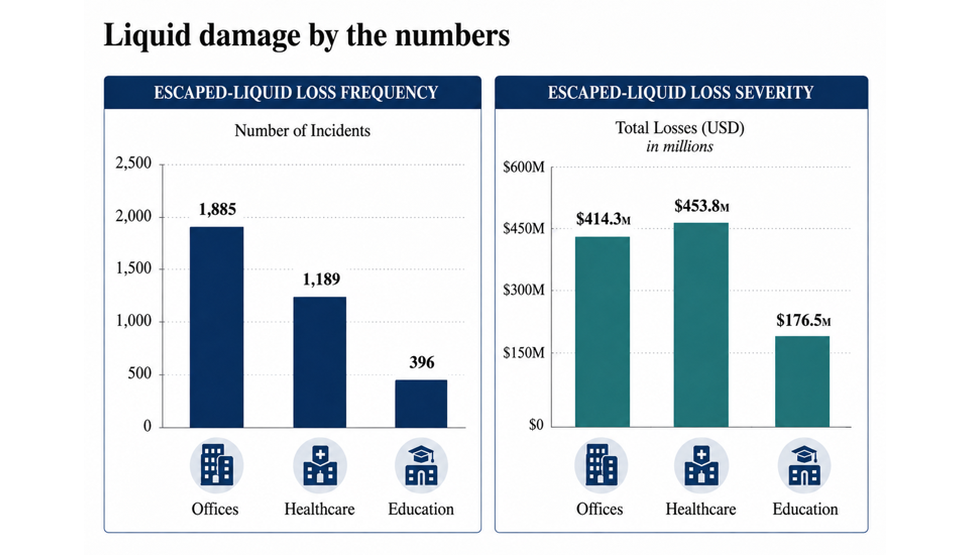
Figure 1. Source: FM loss data. Escaped-liquid losses are both frequent and costly across multiple occupancies.
Climate change is a contributing factor to the frequency and severity of leak-related losses. More extreme cold events increase the risk of pipe failures, while heavier rainfall places greater stress on roofing systems, making roof leak detection an increasingly critical line of defense. Construction practices, changing building use patterns, and the growing prevalence of costly mold contaminations are equally significant drivers of demand for leak detection solutions.
As a result, more new buildings are incorporating leak detection and individual shutoff points during construction, when they are easier to install than during a later retrofit. Owners increasingly want those alerts connected to the building automation system (BAS) for centralized monitoring.
Abnormal-flow monitoring is also emerging as an important early warning tool. In a medical office, water use may rise and fall during the workday but should drop very low when the building is empty. A steady flow in the middle of the night can signal a broken pipe, a fixture left running or another problem, allowing facility teams to intervene when water use falls outside its normal pattern.
Every building leaks, but early detection determines the damage
A Miami-based property management company with a portfolio of vacation condominium properties learned this the hard way. A leak originating on the fifth floor went undetected long enough to reach the first level because the units were largely unoccupied, and no one was there to notice. The losses were significant enough that the building’s insurer ultimately required leak detection across the entire property. Earlier detection would have caught the problem before it escalated, and before the insurer had to intervene.
Leaks, by definition, are typically upstream of where you find them. Water travels through hidden spaces — behind walls, through insulation, across floor assemblies — before becoming visible as a stain or drip somewhere else entirely.
Roof leak detection systems evaluated under FM 7745 offer a useful example of how leak detection is becoming more precise. Some continuously monitored systems incorporate sensors into the roof assembly, while electronic scanning systems can help pinpoint the source of a leak. Earlier and more accurate detection can help facility teams repair a smaller area instead of replacing large sections of a roof simply because the source cannot be found, while also limiting the time water has to be present and damage insulation, decking, and other materials.
Preparing for what’s next: intelligent leak detection
Artificial intelligence is already becoming part of the conversation around leak detection, but many systems described as “intelligent” still follow straightforward logic: if a sensor detects a certain condition, a predetermined response follows. True machine learning introduces a more complex solution. Imagine a leak detector that has issued the same alarm five times, only for each one to be determined to be only a nuisance alert. If the system learns from those events and decides not to issue the alarm the sixth time, it may miss a real leak. That creates a new question for manufacturers, facility owners and certification organizations alike: how do you evaluate a system whose behavior can change as it learns?
FM Approvals is actively planning for and assessing the need for a standard or standards that will define how intelligent detection devices would be assessed for certification. As leak detection, and property loss prevention more broadly, moves toward systems that can learn, adapt and predict, the need for independently verified performance remains critical.